
Max Win Machine by Hacksaw Gaming: Classic Three-Reel Mechanics in a 2026 Release
Max Win Machine is one of the most stripped-back Hacksaw Gaming releases of 2026. Launched on 6 August, the game abandons elaborate grids, cascading combinations and multi-stage bonus sequences in favour of three reels, a single payline and one recognisable winning symbol: the Lucky Seven. That simplicity is paired with a very different risk profile from an ordinary retro-style game, because Hacksaw Gaming rates volatility at the maximum 5/5 and sets the top payout at 10,000 times the stake. The result is a game that looks immediately familiar but behaves far more aggressively than its classic-machine appearance might suggest.
How Max Win Machine Reduces the Slot Format to Three Reels
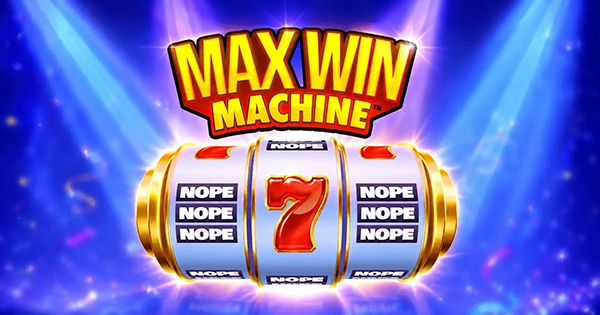
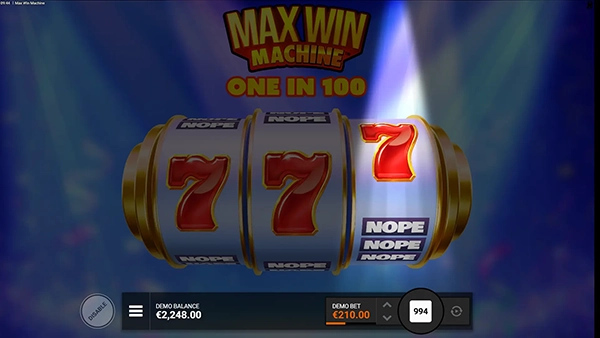
The playing area consists of three reels arranged in a single horizontal row. There is only one payline, so players do not have to follow multiple win patterns or calculate combinations across a large grid. Every result is visible immediately after the spin stops. Hacksaw Gaming has also kept the symbol set unusually small: the reels reveal Lucky Seven symbols and non-paying dead symbols rather than a conventional collection of card values, themed icons, Wilds and Scatters.
This makes Max Win Machine markedly different from many recent Hacksaw Gaming titles, which often rely on distinctive characters, modifiers or layered feature systems. Here, the basic question behind every spin is simply how many Lucky Seven symbols appear consecutively from the leftmost reel. There is no need to interpret a complex paytable before understanding what has happened. A player can identify the outcome almost as soon as the reels settle.
The design deliberately recalls traditional fruit machines and early three-reel games, but it does not reproduce their usual payout structure. Classic machines commonly divide returns between several symbols and relatively modest combinations. Max Win Machine instead concentrates its payout ladder into just three possible Lucky Seven results. This creates a sharp contrast between its old-fashioned visual logic and the high-risk mathematical structure underneath it.
Lucky Seven Payouts and the 10,000x Maximum Win
A single Lucky Seven appearing on the leftmost reel produces a win worth 1x the stake. Two Lucky Seven symbols appearing consecutively from the left pay 10x. The third outcome is dramatically larger: three Lucky Sevens across the complete line award 10,000x the stake, which is also the maximum win permitted by the game. There are no intermediate Lucky Seven combinations between 10x and 10,000x.
The requirement that winning symbols begin on the left is important. A Seven appearing only on the second or third reel does not independently create the listed one-symbol win, while a pair must occupy the first two positions to qualify for the 10x payout. This left-to-right rule keeps the system easy to read while ensuring that the placement of each Seven matters rather than merely the total number appearing anywhere on the reels.
The enormous gap between the 10x two-symbol result and the 10,000x three-symbol result explains much of the game’s character. Adding the final Seven does not simply increase an existing payout by a small step: it changes a relatively ordinary return into the maximum possible result. Players therefore encounter a very compressed paytable in which the largest potential outcome accounts for a substantial part of the game’s appeal, while most spins cannot produce anything resembling that multiplier.
RTP and 5/5 Volatility in Max Win Machine
Hacksaw Gaming lists three RTP configurations for Max Win Machine: 96.22%, 94.28% and 92.20%. Which version is available can depend on the operator and market configuration, so the figure displayed inside the actual game should be checked rather than assuming every casino uses the highest setting. RTP represents a theoretical long-term return calculated across a very large number of wagers; it does not indicate what an individual session will return or provide a forecast for the next spin.
The volatility rating is 5/5, the highest level shown by Hacksaw Gaming. That rating is particularly relevant here because the simple three-reel layout could otherwise give a misleading impression that Max Win Machine is a mild traditional game. Its mathematical profile is built around substantial variance, with a maximum multiplier that sits far above the two smaller listed wins. Short-term results can therefore differ considerably from the theoretical RTP.
Players comparing Max Win Machine with conventional five-reel titles should consider both figures together. RTP describes the theoretical proportion returned over prolonged play, while volatility describes how unevenly those returns may be distributed. A game can have a comparatively high theoretical RTP and still produce pronounced balance swings during a normal session. The 96.22% configuration does not make a 5/5-volatility game predictable, nor does it reduce the significance of stake size.
Why the RTP Version Matters Before Playing
The difference between 96.22% and 92.20% is 4.02 percentage points, which is substantial when comparing alternative configurations of the same game. Because the reels, symbols and visual presentation can remain familiar, two versions may appear identical while operating with different theoretical return settings. Checking the information section within the game is therefore more useful than relying on an RTP figure quoted by a third-party site or remembered from another casino.
Even the highest stated RTP should be interpreted correctly. A 96.22% theoretical return does not mean that a £100 session is expected to finish with exactly £96.22, and it does not create a fixed loss rate for each player. The calculation applies over a very large statistical sample. In a short session, particularly in a game with maximum volatility, actual results may sit far above or below the theoretical average.
The same principle applies when changing stakes. Increasing the wager does not improve the published RTP or make a Lucky Seven combination more likely simply because more money is being risked on each spin. It increases the cash value attached to both wins and losses. For that reason, the stake should be considered in relation to the available playing balance and the game’s 5/5 volatility rather than the size of the 10,000x headline multiplier alone.
What Makes the 2026 Hacksaw Gaming Release Unusual
Max Win Machine stands out in the 2026 catalogue because it achieves its identity through removal rather than the addition of more mechanics. There is no large symbol grid to scan and no extensive collection of standard paying icons to memorise. The core experience is centred on one line and one recognisable paying symbol. Hacksaw Gaming itself described the release as a return to basics, highlighting the three reels, single payline and classic Sevens as its defining elements.
That minimalist approach also makes the relationship between the visible result and the payout unusually transparent. When one Seven lands in the required position, the result is 1x; when two appear from the left, it is 10x; when all three appear, the result reaches 10,000x. There is little ambiguity about why a particular base result pays. For players accustomed to games containing numerous modifiers, expanding symbols and cascading chains, the difference is immediate.
Simplicity should not, however, be confused with low financial risk. Max Win Machine combines one of the easiest paytables to understand with Hacksaw Gaming’s maximum volatility rating. That pairing is arguably the most important characteristic of the release. Its rules can be learned within minutes, yet the distribution of returns means sensible stake selection remains important throughout a session, particularly for anyone who prefers more frequent modest payouts over widely separated results.
Who May Appreciate the Minimalist Three-Reel Design
The game is likely to be easiest to appreciate for players who value direct mechanics and want to know exactly what constitutes a win without learning a long list of special-symbol interactions. The single-payline layout also removes much of the visual activity associated with modern multi-reel games. Every spin focuses attention on the same three positions, making Max Win Machine mechanically accessible even though its volatility remains demanding.
It may be less suitable for players whose main interest lies in elaborate bonus rounds, narrative progression or frequent changes in gameplay. The central structure remains deliberately narrow, and the appeal comes from the contrast between the modest 1x and 10x outcomes and the exceptional 10,000x top result. Anyone choosing the game primarily because it resembles an old three-reel machine should therefore check the volatility and RTP information before treating it like a conventional low-complexity classic.
As a 2026 release, Max Win Machine demonstrates that a new game does not necessarily require more reels or increasingly elaborate rules. Hacksaw Gaming has instead used one of the oldest recognisable casino formats and paired it with an unusually concentrated payout structure. Three reels, a single line, Lucky Seven symbols, a 5/5 volatility rating and a maximum win of 10,000x define the entire concept. Its mechanics are exceptionally easy to explain, while the mathematics behind them make careful stake management just as relevant as in far more complicated modern games.
-
Max Win Machine by Hacksaw Gaming: Classic Three-Reel M...
Max Win Machine is one of the most stripped-back Hacksaw …
-
 Quickspin in 2026: Mobile Design, Bonus Features and Mo...
Quickspin remains one of the recognisable Swedish names in online …
-
 Roulette’s Evolution: From Casino Floors to Virtual Rea...
In the opulent world of casinos, few games have stood …